Implant Treatment
Oral and dental health is one of the cornerstones of human physiology. Any loss occurring in the mouth, which is the beginning of the digestive system, can create not only regional but also systemic effects. Tooth losses caused by cavities, periodontal (gum) diseases, traumas, or developmental disorders can lead to impairment of chewing function, changes in eating habits, speech disorders (phonation), and the emergence of psychosocial problems due to aesthetic concerns. Modern dentistry accepts the method with the highest ability to mimic natural teeth, namely Implant Treatment protocols, as the gold standard in replacing lost teeth.
Serving in the Thrace region, Kırklareli Dental Clinic Atlas Sea Dental performs implant applications suitable for the anatomical structures of patients within the framework of sterilization and surgical discipline.
What is a Dental Implant? Structural Features and Biocompatibility
Dental implants are artificial roots surgically placed in the jawbone to mimic the root part of missing teeth. These structures are produced from “Grade 4” or “Grade 5” titanium alloys whose biological compatibility with the human body has been proven. The main reason for choosing titanium is its ability to chemically and physically fuse with bone tissue, called “osseointegration.”
An implant system basically consists of three components:
- Fixture (Body): The screw-shaped part placed inside the bone and undertaking the task of the tooth root.
- Abutment: The intermediate piece screwed onto the implant after the ossification process is completed and carrying the prosthesis.
Superstructure (Prosthesis): The porcelain or zirconium part visible in the patient’s mouth, providing chewing and aesthetics.
The harmony of these three components is one of the most important factors determining the success of Implant Treatment. Implant surfaces undergo special nanotechnological processes such as laser roughening or sandblasting to increase the adhesion of bone cells (osteoblasts).
Why Implant Treatment? Advantages and Preventive Dentistry
Traditional prosthetic methods (fixed bridges) require the reduction (preparation) of healthy teeth on both sides of the gap to complete a tooth deficiency. This leads to the loss of healthy tooth tissue. However, Implant Treatment focuses only on the missing area without damaging neighboring teeth. In this aspect, it is the most protective treatment method.
Another critical advantage is the preservation of bone tissue. The alveolar bone in the area where tooth extraction is performed begins to melt (atrophy) over time because it remains dysfunctional. This melting can cause the facial profile to collapse and the patient to look older than they are. Implants stimulate the bone by transmitting chewing forces directly to the bone and prevent its melting. In patients using removable total dentures, problems such as the denture moving, coming out while speaking, and causing sores are completely solved with Implant Treatment; patients achieve fixed tooth comfort.
Who is it Suitable For? Indications and Systemic Evaluation
For implant application, the patient’s general health status must be suitable for the surgical procedure.
- Bone Development: Implant Treatment is not recommended for individuals who have not completed their growth and development (usually under 18) because the jawbone continues to take shape. There is no upper age limit; it can be safely applied even to patients aged 80-90 whose systemic condition is suitable.
- Diabetes: Wound healing may be slow in diabetic patients. However, if the disease is under control and HbA1c (three-month blood sugar average) values are within certain limits, there is no harm in performing implants.
- Heart Conditions: The procedure can be performed by consulting the patient’s cardiologist and regulating blood thinners.
- Smoking: Since smoking reduces intraoral blood supply, it increases the risk of infection and makes it difficult for the implant to fuse with the bone. Therefore, Kırklareli Dental Clinic Atlas Sea Dental physicians strongly recommend quitting or reducing smoking during the treatment process.
Detailed Treatment Process and Clinical Protocols
Implant Treatment is not a simple “screw insertion” procedure but a surgical and prosthetic process requiring detailed planning. In Atlas Sea Dental clinical protocols, this process proceeds systematically:
- Radiological Diagnosis and Planning: The key to successful treatment is correct diagnosis. In addition to two-dimensional panoramic x-rays, the width, height, and density of the jawbone are measured in millimeters with three-dimensional Dental Volumetric Tomography (CBCT). The location of anatomical risk factors such as the nerve canal in the lower jaw and sinus cavities in the upper jaw is determined. At this stage, virtual surgical planning is made, and the diameter and length of the implant are selected.
- Surgical Operation: The procedure is performed under sterile operating room conditions and local anesthesia. The patient does not feel pain during the procedure. The gum is opened surgically (flap operation) or, in suitable cases, a socket is prepared on the bone with a seamless method (flapless). The implant is placed in the bone at the determined torque value. A standard Implant Treatment surgery takes an average of 15-20 minutes per implant.
- Healing and Osseointegration: It is the time required for the implant to biologically integrate with the bone. This period averages 3-4 months for the upper jaw and 2-3 months for the lower jaw. If bone powder (graft) is used, this period may be extended. It is important that no load is placed on the implant during the healing period.
- Healing Cap and Prosthesis Construction: At the end of the waiting period, the top of the implant is opened, and a “healing cap” (gingiva former) is attached to shape the gum. An impression is taken 1 week later. In the laboratory stage, porcelain or zirconium teeth suitable for the patient’s oral structure are prepared and fixed onto the implant.
Advanced Surgical Techniques in Insufficient Bone Conditions
In long-term toothlessness or serious infections, the jawbone may have melted too much to perform an implant. In these cases, bone augmentation procedures are applied before or simultaneously with Implant Treatment:
- Sinus Lifting: The floor of the sagging sinus cavity in the posterior region of the upper jaw is lifted upwards, and bone powder (graft) is placed in between.
- Guided Bone Regeneration (GBR): In cases where bone width is insufficient, bone volume is increased using bone powders and barrier membranes.
Split Osteotomy: It is the process of expanding thin bones. Kırklareli Dental Clinic Atlas Sea Dental offers the opportunity to perform implants even for patients with bone insufficiency with advanced surgical techniques.
Immediate Implantation and Loading (Same Day Teeth)
In the classical protocol, bone healing is expected after tooth extraction. However, in the “Immediate Implantation” technique, the implant is placed in the same socket in the session the tooth is extracted. If the implant’s resistance to hold onto the bone (primary stability) is high enough (over 35 Ncm), a temporary fixed tooth can be attached to the patient on the same day by performing “Immediate Loading.” This method eliminates the patient’s toothless period and relieves aesthetic anxiety. It is one of the methods that increase patient comfort the most among Implant Treatment protocols.
All-on-4 and All-on-6 Concept
In fully edentulous patients, especially if bone melting is excessive in the posterior regions and there are anatomical obstacles such as nerves/sinuses, it is possible to have fixed teeth without performing advanced surgery. In the All-on-4 or All-on-6 technique, 4 or 6 implants are placed in the jaw at strategic angles (posterior implants at 30-45 degree angles). Fixed temporary prostheses are screwed onto these implants on the same day. Kırklareli Dental Clinic Atlas Sea Dental physicians frequently apply this biomechanical solution for fully edentulous patients who do not want to use removable dentures.
Pain in Implant Treatment
The biggest concern of patients is the pain they will feel during or after the procedure. Since the surgical procedure is performed under local anesthesia, pain is not felt during the operation. After the operation, when the effect of anesthesia wears off, a slight throbbing and swelling (edema) may occur. This situation is easily controlled with simple painkillers and antibiotics prescribed by the physician. The patient usually returns to normal life within 1-2 days. Compared to tooth extraction, the healing process after Implant Treatment is found more comfortable by patients.
Post-Treatment Nutrition and Care
Hot food and drinks should be avoided for the first 24 hours after the implant operation, and soft foods should be consumed. During the healing process (first 3 months), hard nuts, etc. foods should be avoided so that excessive load is not placed on the implants. The life of the implants depends on the care the patient shows for oral hygiene. Neglecting care with the thought “implants do not decay” causes a disease called “Peri-implantitis,” which leads to inflammation of the gum and bone around the implant. This situation can result in implant loss.
- Brushing twice a day,
- Use of interdental brush and dental floss,
- Use of oral irrigator,
- Check-ups to be made every 6 months at Atlas Sea Dental clinic ensure that implants are used for a lifetime.
Digital Dentistry and Surgical Guides
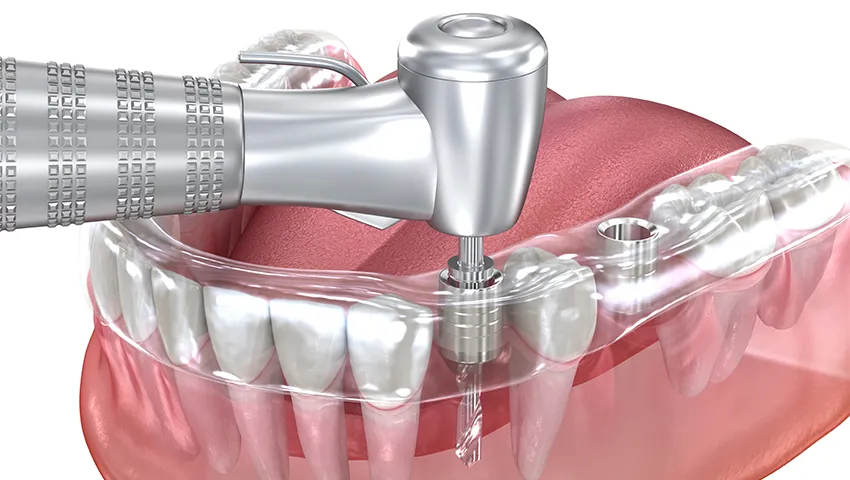
With the development of technology, Implant Treatment is now managed with digital workflows. Tomography data taken from the patient and intraoral scan images are combined in a digital environment. The position, angle, and depth of the implant are planned virtually on the computer. According to this plan, “Surgical Guides” are produced with 3D printers. Thanks to these guides, the physician places the implant exactly at the planned point without cutting the gum (seamlessly). This method shortens the operation time, reduces the error to zero, and accelerates the healing process. Kırklareli Dental Clinic Atlas Sea Dental offers this comfort to its patients by using digital dentistry possibilities.
Factors Affecting Success and Implant Life
The success rate of implants in scientific literature is between 95-98%. Factors affecting success are:
- Physician Experience: Surgical technique and prosthetic planning.
- Implant Quality: Use of FDA and CE approved implant brands with advanced surface technology.
- Patient Compliance: Oral hygiene and smoking.
- Sterilization: Ensuring operating room conditions.
A well-maintained implant can serve for a lifetime. However, mechanical parts (screw, porcelain) may need maintenance or replacement over time.
Regional Health Service and Access
The Thrace region has an important place in health tourism with the quality services it offers in the field of dentistry. Patients in Kırklareli and its surroundings can receive world-class service in local clinics without having to go to big cities for advanced surgical procedures such as Implant Treatment. Kırklareli Dental Clinic Atlas Sea Dental gives confidence by standing behind the treatment with the implant passport and warranty certificates it offers to the people of the region. Post-treatment controls being made in an accessible location is a great advantage for the long-term success of the implant.
Implant Treatment in dentistry is the most advanced rehabilitation method based on biological foundations that restores lost function and aesthetics. These systems, which eliminate the feeling of insecurity created by removable dentures, protect healthy teeth, and stop bone melting, are a direct investment in quality of life.
Whether it is a single tooth deficiency or total edentulism, a suitable implant solution is available for every case. However, the success of the treatment is possible with correct indication, use of quality materials, sterilization chain, and physician experience. Current implant protocols applied within Atlas Sea Dental aim to ensure that patients smile with confidence and eat freely. Do not postpone your tooth deficiencies for a healthy future and a strong chewing system; regain your life comfort with implant treatment.