Implant Treatment in Bone Deficiencies and Regeneration Methods
Dental implant applications are accepted as the most successful and physiological method for eliminating tooth deficiencies today. However, the most fundamental condition for an implant to be long-lasting and healthy is the presence of jawbone of sufficient volume and quality to surround the implant. Unfortunately, serious melting (atrophy) can occur in the jawbone as a result of long-term toothlessness, gum diseases, traumatic tooth extractions, or pathologies such as cysts/tumors. While in the past it was seen as impossible to perform implants in such cases or patients were condemned to removable dentures, thanks to modern surgical techniques today, Implant Treatment in Bone Deficiencies can be successfully applied. Offering advanced implantology services in the Thrace region, Kırklareli Dental Clinic Atlas Sea Dental offers biological and scientific solutions to its patients even in cases where bone volume is insufficient.
Why Does Jawbone Melt? Biological Process
Bone tissue is a dynamic structure that works on the “use it or lose it” principle. Natural tooth roots transmit chewing forces to the bone, allowing the bone to remain alive and renew itself. When a tooth is extracted, this stimulation disappears, and the part of the bone holding the tooth, called the “alveolar bone,” loses volume over time (resorption).
The main causes of bone insufficiency are:
- Long-Term Toothlessness: Bone loss is at its fastest level in the first 6 months after extraction. As years pass, the jawbone becomes thin like a knife-edge.
- Periodontal Diseases: Gum infections melt the bone, leading to tooth loss and leaving behind weak bone.
- Traumatic Extractions: Breaking or damaging of bone walls during tooth extraction.
- Use of Removable Dentures: The constant pressure exerted by dentures on the bone accelerates melting.
In such cases, standard implant protocols cannot be applied, and Implant Treatment in Bone Deficiencies algorithms come into play.
Radiological Diagnosis and Three-Dimensional Planning
Correct evaluation of bone volume is vital for the success of the treatment. Traditional panoramic x-rays show only the height of the bone; they do not show its width (thickness). Therefore, in Kırklareli Dental Clinic Atlas Sea Dental protocols, three-dimensional analysis with Dental Volumetric Tomography (CBCT) is definitely performed in suspicious cases. Thanks to tomography, the millimeter dimensions, density of the bone, and the location of nerve canals and sinus cavities are clearly determined. This analysis is the first and most important step of planning Implant Treatment in Bone Deficiencies.
Bone Formation Methods (Augmentation)
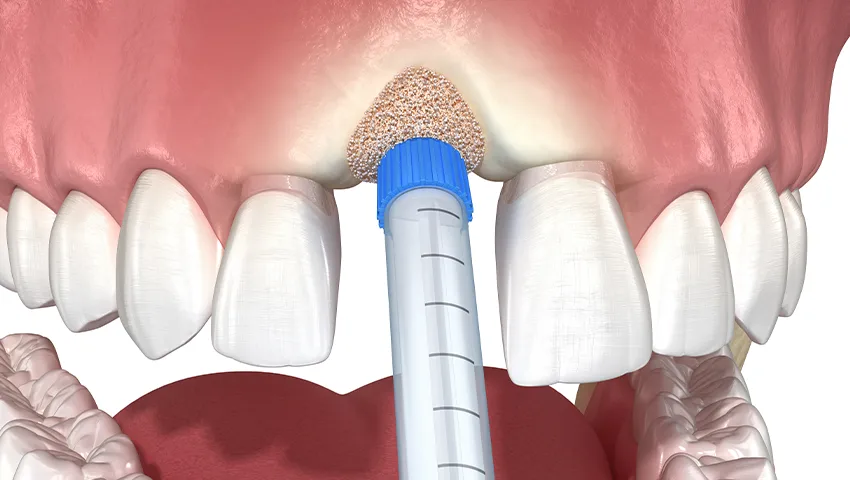
Procedures applied to increase insufficient bone volume are generally called “Bone Augmentation” or “Grafting.” Bone powders (grafts) and barrier membranes are used in these procedures.
- Sinus Lifting Operation
In the posterior region of the upper jaw, there are air cavities called “maxillary sinuses” just above the tooth roots. When teeth are lost, these cavities sag downwards, and bone height decreases. The most frequently applied procedure within the scope of Implant Treatment in Bone Deficiencies is sinus lifting.
- Open Sinus Lifting: A window is opened from the side wall of the sinus, the sinus membrane is lifted upwards, and bone powder is filled into the gap in between. Usually, implants are placed 6 months after this procedure.
- Closed Sinus Lifting: It is done by fracturing the sinus floor upwards while preparing the implant socket. It provides 3-4 mm bone gain, and the implant can be placed in the same session.
- Guided Bone Regeneration (GBR)
In cases where bone width is insufficient, a part of the implant may remain exposed. In this case, bone powder (bovine or synthetic source) is placed around the implant and covered with a resorbable membrane (collagen cover). This process prevents gum tissue from collapsing into the bone area, allowing new bone formation underneath. Atlas Sea Dental physicians frequently use this method in aesthetic zone implants.
- Block Bone Grafts (Onlay Grafts)
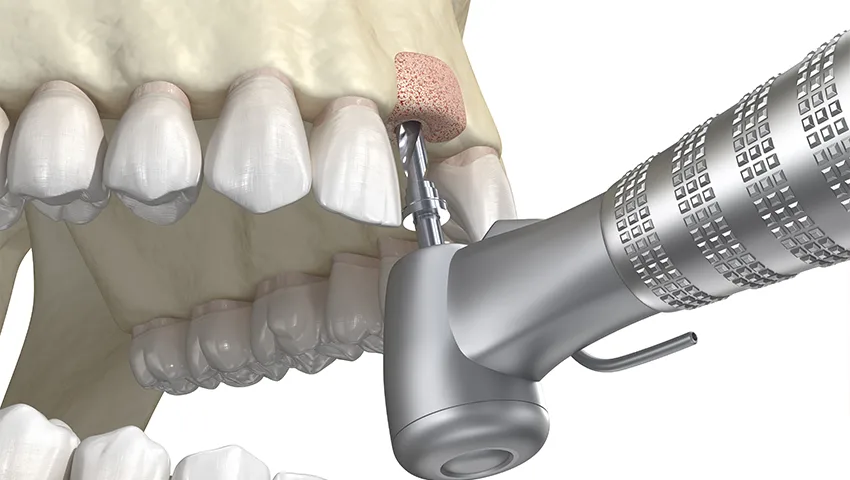
In very serious bone losses, grafts in powder form may not be sufficient. In this case, block bone pieces taken from the patient’s own jaw (usually the chin tip or wisdom tooth area) are fixed to the missing area with screws. Since this method carries the patient’s own living bone cells (autogenous graft), the success rate is very high. It is one of the most advanced surgical techniques for Implant Treatment in Bone Deficiencies.
- Split Osteotomy (Bone Expansion)
If the bone height is sufficient but the width is very thin (knife-edge), the bone is split in two with special instruments (piezo surgery), expanded, and the implant is placed in between.
Materials Used: Bone Powder (Graft) Types
Bone grafts used in these treatments are obtained from different sources:
- Autogenous Graft: The patient’s own bone. It is the gold standard.
- Allograft: Processed bones of human origin obtained from tissue banks.
- Xenograft: Animal-origin (usually bovine or equine) bones. It serves only as a scaffold and is absorbed by the body over time.
Synthetic Graft: Biocompatible materials produced in the laboratory.
Kırklareli Dental Clinic Atlas Sea Dental manages the Implant Treatment in Bone Deficiencies process by choosing the most suitable graft type according to the needs of the case.
Alternative Solutions Not Requiring Advanced Surgery
It may not be mandatory to perform bone formation (grafting) in every patient, or the patient may not prefer long waiting times (6-9 months). In these cases, techniques that “bypass” bone insufficiency come into play.
All On Four Technique
It is a technique where implants are placed at an angle to avoid bone melting in the posterior region and sinus cavities in fully edentulous patients. In this way, fixed teeth can be made without the need for a sinus lifting procedure. Among Implant Treatment in Bone Deficiencies protocols, it is one of the methods offering the fastest solution to patients.
Short Implants
In cases where vertical bone height is borderline and close to the nerve canal, implants that are shorter than standard (6mm – 8mm) but wider in diameter can be used. These implants with special surface structures eliminate the risk of advanced surgery.
Zygoma Implants
In cases where the bone in the upper jaw has completely melted and will not hold a graft in any way, these are very long implants placed in the cheekbones (zygoma). This method is the last resort treatment applicable in clinics with advanced surgical competence like Atlas Sea Dental.
Treatment Duration and Healing
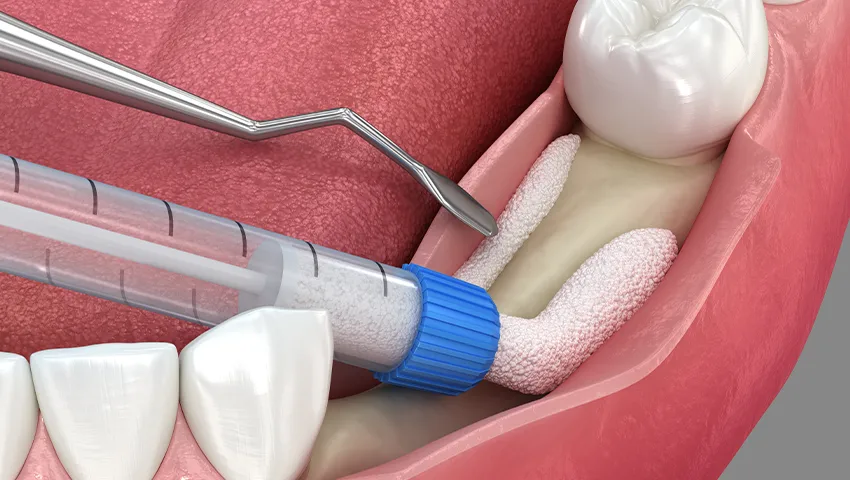
While the waiting period in a standard implant treatment is 2-3 months, this period extends when Implant Treatment in Bone Deficiencies is applied. Because it takes time for the added bone powder to integrate with the body and harden.
- Sinus Lifting: 6 months waiting period.
- Block Graft: 4-6 months bone fusion, followed by implant construction and 3 months more waiting.
Although this process requires patience, the solid foundation obtained in the end ensures the implant is used for a lifetime.
Risk Factors and Patient Compliance
Bone formation procedures are sensitive procedures. The most important factor affecting success is smoking. Since smoking impairs tissue nutrition, it can cause the graft to become infected and melt. Therefore, Kırklareli Dental Clinic Atlas Sea Dental physicians may require smoking cessation in patients who will undergo advanced surgery. Also, diabetes must be under control, and oral hygiene must be perfectly maintained.
Access to Regional Service and Technology
The Thrace region has caught up with Istanbul standards in the field of dental surgery. Patients in Kırklareli and its surroundings do not have to go out of the city for complicated procedures such as Implant Treatment in Bone Deficiencies. The use of advanced imaging methods, piezo surgery devices (ultrasonic bone cutters), and current biomaterials has increased the success rate in local clinics. Kırklareli Dental Clinic Atlas Sea Dental serves the people of the region by combining this technological infrastructure with sterilization discipline.
Treatment costs are higher than standard implant applications because the biomaterials used (bone powder, membrane, screw sets) are costly, and the procedure requires surgical expertise. However, the gained bone tissue and the functional result obtained offer an increase in quality of life that covers this cost.
Tooth deficiency and accompanying bone melting are no longer an unsolvable problem. The sentence “Your bone has melted, implants cannot be done” has largely lost its validity in modern dentistry. Implant Treatment in Bone Deficiencies is a scientific reality that restores lost tissue with biological methods and offers the patient fixed tooth comfort again.
Many techniques, from sinus lifting to block grafts, from guided tissue regeneration to angled implants, are powerful weapons in the hands of the physician. What matters is correct diagnosis and personalized treatment planning. Expert physicians within Atlas Sea Dental analyze bone volume in detail and determine the method that tires the patient the least and gives the most precise result. Remember, a solid bone foundation is a must for a healthy implant, and creating this foundation is possible with today’s technology.